


Article: Inside Casa GTO: A Home for Cars, Culture and Conversation
Inside Casa GTO: A Home for Cars, Culture and Conversation
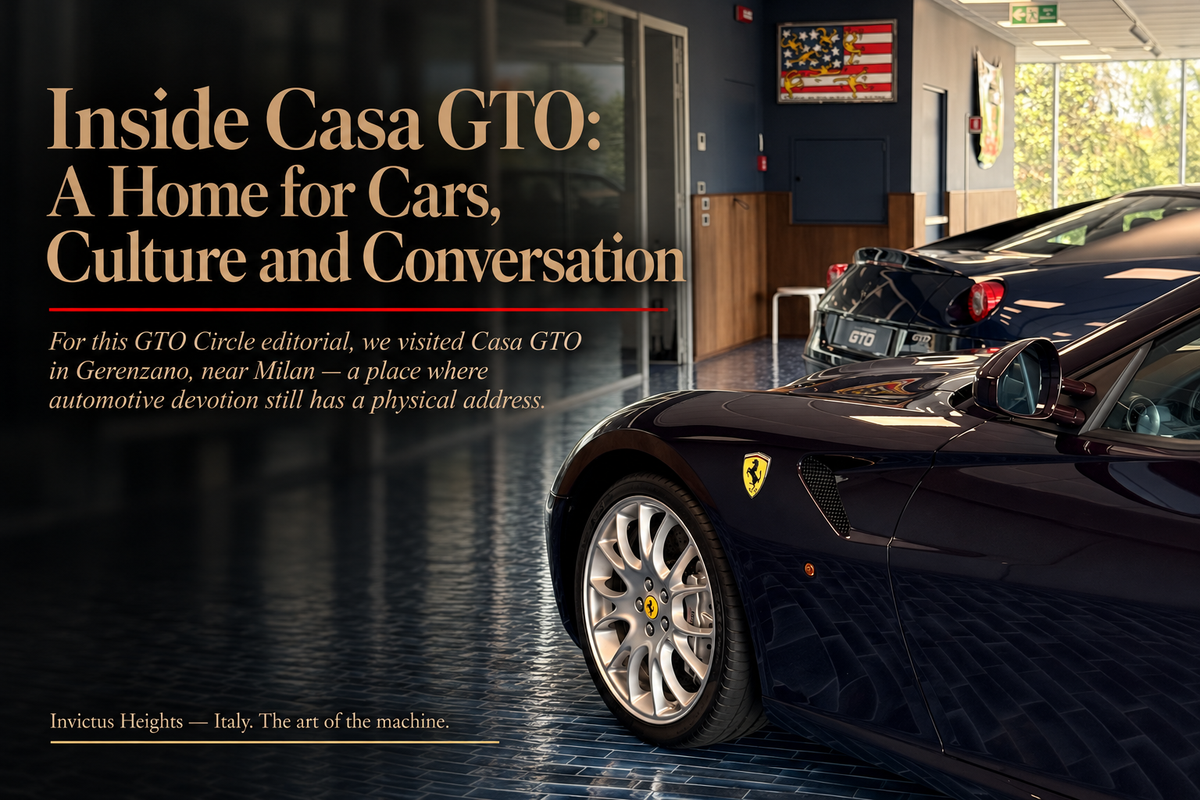
For this GTO Circle editorial, we visited Casa GTO in Gerenzano, near Milan — a place where automotive devotion still has a physical address.
Some places are not only built to display cars. They are built to hold conversations, memories, introductions, small rituals and quiet moments of recognition between people who understand the same language. In the automotive world, this matters more than we often admit.
For this new path, there was perhaps no better place to begin than Casa GTO.
The name was already familiar to us, but not only because of GTO Circle. During the visit, Juan told us that the name Casa GTO also comes from a deep reverence for the Ferrari 288 GTO.
That made the connection even more natural. I was still a child when the Ferrari 288 GTO was launched, but I still remember the aura around that car. The sense of reverence. The feeling that something important had arrived. That memory and feeling stayed with me, today, when I stand in front of a Ferrari 288 GTO, I almost feel the need to bow — as one should before the mother of the modern supercar.
Perhaps that is also why the name Casa GTO felt so close. It speaks a language we understand: not only performance, not only rarity, but respect.
And yes, that sense of reverence is something I miss when new Ferraris are revealed lately.
A Different Way of Seeing

In June 2026, GTO Circle visited Casa GTO in Gerenzano, just north of Milan, with Invictus Heights bringing the editorial eye to the story.
We were welcomed by Juan Carreño, from GTO MOTORS, who introduced us to Casa GTO and shared the thinking behind this new space: why it was created, what it wants to offer, and how it differs from the usual idea of a car showroom.
Casa GTO was born as a spin-off from GTO MOTORS, an established name in the Ferrari service world. But Casa GTO feels like a different chapter: less like a traditional showroom, more like a house built around a certain way of seeing cars.
As Juan explained, Casa GTO opened its doors in 2025, with Tutto Bene hill climb becoming one of the first occasions to bring the space and its philosophy to life. From the outset, the intention was to create a different kind of automotive destination: a place offering a full 360-degree service to its clients — sourcing, selling, events, storage and more — without limiting the vision to one narrow category of cars.
The universe of Casa GTO can move from competition cars to rally icons, from a Clio Williams to a Mercedes-Benz CLK GTR. The common point is not the badge, the value or the market category. The common point is passion.
That makes sense when you look at the wider world behind it. Eugenio Amos, President of GTO MOTORS and one of the names connected to Casa GTO, is also known for Automobili Amos and the Lancia Delta Integrale Futurista — a project that did not simply restore an icon, but reinterpreted it with respect, engineering and a very personal idea of automotive memory. That background matters.
Because Casa GTO does not feel like a place created only for transaction. It feels like a place created by people who know that cars are identity, stories and belonging.
Built Around Passion
During the interview, the answer to “why Casa GTO?” was simple: to do something different from the usual car showroom. To create a warm, comfortable space where clients can feel at home, share a common passion, discuss cars, exchange knowledge and see special machines up close.
The space reflects that intention.
There is a kitchen and bar area. There are lounge corners. There is even the kind of room where a conversation could easily turn into a game of ping pong. Nothing feels accidental. Every detail seems placed with intention.
Then there is the storage.
Not just storage in the practical sense. More like a vertical wall of icons: cars carefully kept, one above the other, creating the feeling of an archive made of metal, colour, memory and trust.
It gives the space weight.
It says that important cars are not only shown here. They are looked after.
Reading the Room
Inside Casa GTO, the core philosophy becomes visible through the cars themselves.
At the time of our visit, the space held several remarkable pieces. One of them was a Lancia Delta Integrale Futurista by Automobili Amos, one of only twenty examples created. With a reported original transformation price in the €300,000–€350,000 range and market benchmarks now moving around the half-million-dollar mark, it is not simply another restomod. It is a reinterpretation of an Italian rally icon, rebuilt with intention, precision and a very personal understanding of what the Delta Integrale still means.
Nearby, a Mercedes-Benz CLK GTR brought a completely different kind of presence. A road-going race car born from the GT1 era, produced in only twenty coupés, and today sitting in the kind of market territory where eight figures are no longer theoretical.
This is not simply a valuable car because it is rare.
It is valuable because it belongs to a moment when manufacturers still built extreme machines to justify racing ambition.
And then, closer to the heart of GTO Circle, there was a Ferrari 599 GTO in Blu Scozia.
Some cars do not need much explanation here. The Ferrari 599 GTO is one of them. One of 599 built, it sits today in a market that can move from around the million mark in Europe to over two million dollars for exceptional, low-mileage US examples.
But for us, the value was not the reason it mattered.
In Blu Scozia, it had a quiet authority: less obvious than red, perhaps even more magnetic because of it.
A second 599 — a Ferrari 599 GTB finished in a deep wine tone and fitted with a manual gearbox — added another kind of gravity to the room. That detail matters.
Factory manual Ferrari 599 GTBs are among the rarest modern Ferraris, with only around thirty believed to have left Maranello with the traditional six-speed gated manual transmission. Recent European auction results have already moved above the €600,000 mark. But beyond the value, that small metal gate carries the weight of an ending.
In a world that moved quickly toward paddles and electronics, it reminds us of the last chapter of a certain kind of Ferrari.
The cars felt like chapters of different eras, different languages, different ideas of performance — but all held together by the same thread: memory, passion, and the desire to keep special cars close enough to be seen, discussed and understood.
A Room for Devotion
This is exactly the kind of place I always look for.
When I travel for work, I often try to use the opportunity to visit special dealers, private collections, automotive spaces and garages with a clear identity. And when I plan a personal trip, the pleasure is often in building the route around these places: stops across Europe where cars are not only stored or sold, but understood.
That is why this visit felt worth documenting: Casa GTO is one of those places where automotive culture still has a physical address.
Dealers, garages, private spaces, ateliers, showrooms and meeting rooms where deep passion is not only spoken about, but lived.
A car dealer today is no longer just a commercial address. At least, the good ones are not. A serious automotive space has the chance to become a meeting point, a cultural signal, a place where trust is built before business is discussed.
This is especially true in the world of Ferrari and collector cars.
These cars do not live only through numbers, specifications or market value. They live through people. Through stories. Through the way someone remembers a drive, a detail, a sound, a model, a chassis, a moment.
This is where the connection between GTO Circle and Invictus Heights becomes natural.
GTO Circle remembers. It remembers the cars, the details, the stories and the people around them. It exists because automotive culture needs memory, especially at a time when so much of that culture is becoming fast, digital and disposable.
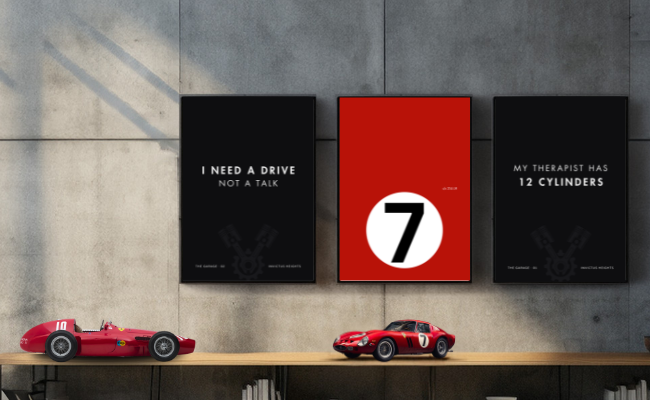
Invictus Heights preserves. It gives that same passion a more permanent form — through editorials, objects, art, conversations and curated projects that treat automotive culture as something worth protecting.
What makes a space meaningful is not decoration. It is intention.
A table can become a place for trust.
A wall can become a story.
A coffee can become the beginning of a relationship.
A car, placed in the right context, becomes more than inventory. It becomes identity.
This is why spaces like Casa GTO matter.
They remind us that automotive culture is not only preserved through archives, registries or photographs. It is also preserved through places where people still meet, talk, look closely, ask questions and stay longer than planned.
In a world that keeps pushing everything online, the physical space becomes even more important.
Because this kind of passion still needs a room.
And some cars still deserve to be encountered, not just seen.
A warm thank you to Juan Carreño, Edoardo Giudici Saraval and the Casa GTO team for the welcome, the conversation and the time spent opening the doors of this special place.
This is what I look for when I enter an automotive space: places that speak of the passion of the people who built them, and of the people who keep them alive.
Because in the end, the most meaningful automotive spaces are never only about the cars inside.
They are about the culture they protect.
Invictus Heights — Italy

Written by Emanuela Petrelli
Emanuela Petrelli is the founder of Invictus Heights, a house preserving automotive culture through art, editorials and collector objects. She curates GTO Circle, a Ferrari community of owners and enthusiasts, and writes on cars and marques through the lens of brand, meaning and design.


Leave a comment
This site is protected by hCaptcha and the hCaptcha Privacy Policy and Terms of Service apply.