


Is the Ferrari Luce Still a Ferrari?
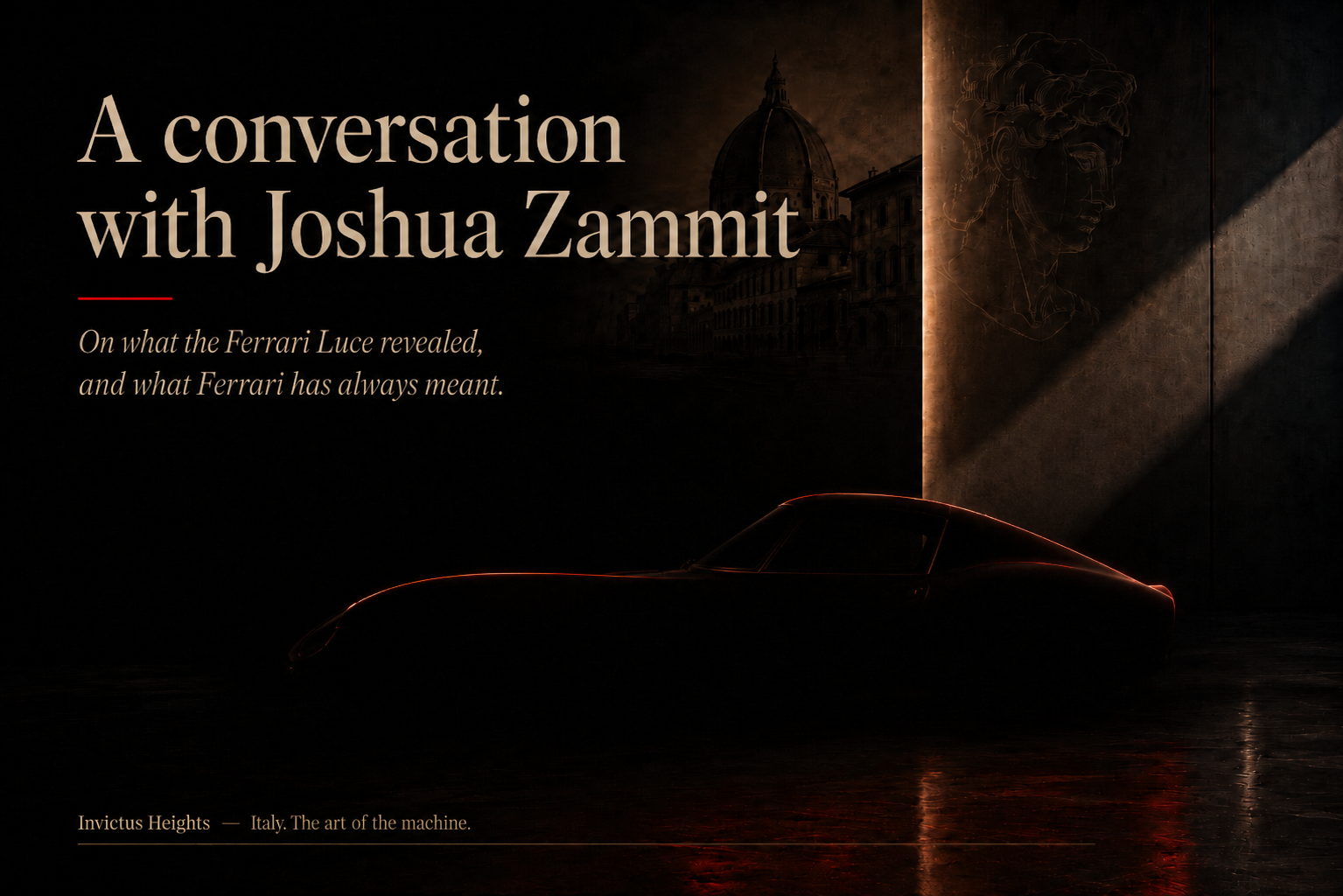
A conversation with Joshua Zammit — on what the Ferrari Luce revealed, and what Ferrari has always meant.
Editorial note
In May 2026, Ferrari revealed the Luce — its first fully electric car. The engineering was praised. The design was not. And for once, the reaction was almost united. From inside the Ferrari world and far outside it — from people who usually agree on nothing — the answer came back the same. No.
Millions of comments, posts and articles followed. The one that stayed with me was a single post on LinkedIn, written by Joshua Zammit — a founder and management consultant I have worked with. In a few lines, he said what I had been feeling, and said it well. It resonated with me, deeply.
I decided to keep this conversation here, so it does not disappear.
It is also a pleasure to welcome Joshua Zammit to Invictus Heights through this exchange — not as an interview, but as a reflection worth preserving.
His words appear exactly as he wrote them. So do mine. This is the exchange, as it happened.
Joshua Zammit — Reflection on LinkedIn
I am sure that by now you have seen or heard about the new Ferrari Luce. The car may well be technologically impressive, but I could not avoid the uneasy feeling it awakened in me. To me, it represents much of what is going wrong in modern society.
Ferrari is not just a car manufacturer. It is Italy on four wheels.
It carries the spirit of a country that gave the world beauty, passion, artistry, style, theatre, romance and design. A country synonymous with la bella vita.
Ferrari represents emotion, soul and character. And that is precisely why people fell in love with it.
The Ferrari Luce feels detached from the cultural identity that made Ferrari iconic. Remove the badge and much of what remains could belong almost anywhere. It no longer feels unmistakably Italian. Nor does it feel unmistakably Ferrari. It no longer evokes that uniquely Italian combination of elegance, sensuality, drama and mechanical artistry.
Ferrari is special because of what it awakens in people: romanticism, theatre, imagination and emotion.
It is the objectification of the Italian psyche: passionate, expressive, emotional and unapologetically alive.
There is absolutely nothing wrong with evolution. Tradition should evolve and every great brand must adapt with time. But there is a profound difference between modernising a legacy and abandoning the DNA that made it meaningful in the first place.
And this is where the parallel with modern society emerges.
We are living in an age that increasingly strips away distinction in favour of uniformity. Cities look the same. Brands sound the same. Architecture has become interchangeable. Culture is becoming flattened and sanitised into something globally acceptable but emotionally empty.
In the process, we are slowly discarding the very things that separate humanity from mere functionality: culture, symbolism, beauty, identity, emotion, craftsmanship and creative expression.
For me, the tragedy is not that Ferrari is changing.
The tragedy is that the world increasingly celebrates the loss of identity as progress.
Emanuela Petrelli — Reply from Invictus Heights
Every word of this. The tragedy is not Ferrari changing. The tragedy is that we have normalised calling the loss of identity “progress.” In every field. Not just automotive. Ferrari was one of the last things that refused to be like everything else. That is precisely why it mattered so much to so many people. Yesterday I asked my community what Ferrari means to them. The answers were not about cars. They were about identity, memory, belonging. That is what is at stake.
Joshua Zammit — Reply to my comment
Yes, because Ferrari does not simply sell cars. It sells aspiration. Ferrari is almost mythological. Like a phoenix, it rose from the ruins of post-war Italy: shaped by hardship, fuelled by ambition, and transformed into one of the world's great icons.
When you look at a Ferrari, you are not merely looking at a car. You are looking at an idea. An image of what you as a human can become.
And when people buy Ferrari, they are not simply buying an object. They are buying a fragment of and participating in the Italian psyche.
That is why reactions to Ferrari are so visceral. Because Ferrari was never purely automotive. It is cultural symbolism that gives you an ideal to look up to. What the Ferrari Luce did is it diluted that identity which once felt purely Italian and unmistakably alive.
Published with Joshua's blessing, exactly as it happened.
Joshua Zammit is a founder, entrepreneur, business mentor, management consultant and researcher based in Malta. His work sits at the intersection of business strategy, leadership, aviation, organisational development and cultural observation.
I am Emanuela Petrelli, is the founder of Invictus Heights, with a background in international events, hospitality, brand experience and automotive culture. Through Invictus Heights, she explores the art of the machine, collector identity and the cultural value of automotive heritage.
Invictus Heights — Italy The art of the machine.

Written by Emanuela Petrelli
Emanuela Petrelli is the founder of Invictus Heights, a house preserving automotive culture through art, editorials and collector objects. She curates GTO Circle, a Ferrari community of owners and enthusiasts, and writes on cars and marques through the lens of brand, meaning and design.


Leave a comment
This site is protected by hCaptcha and the hCaptcha Privacy Policy and Terms of Service apply.