



Article: The Ferrari 250 GTO Registry
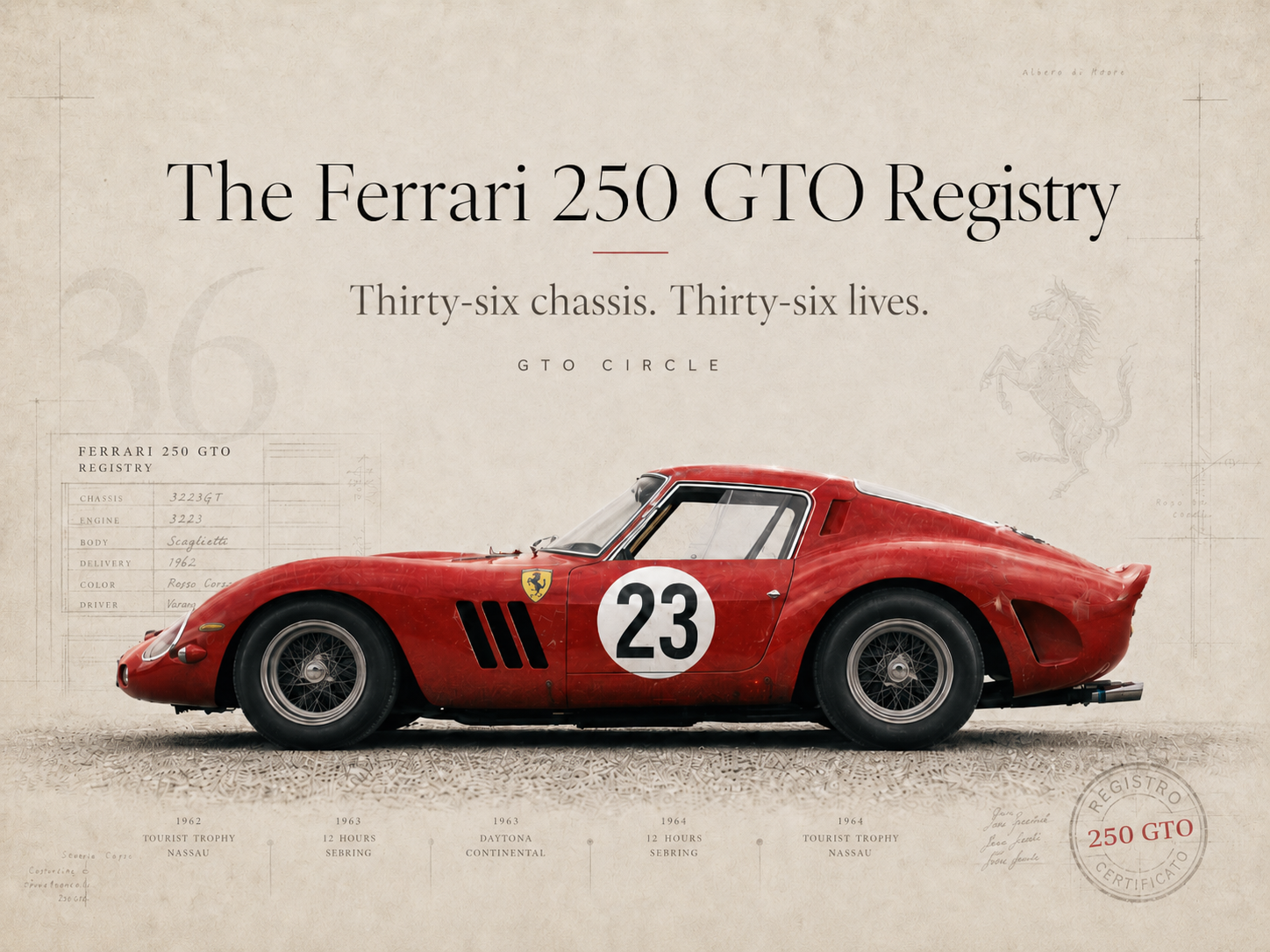
The Ferrari 250 GTO Registry
Thirty-six chassis. Thirty-six lives.
Before the Ferrari 250 GTO became the most desired collector car in the world, it was a solution to a racing problem.
Born in Maranello at the beginning of the 1960s, the 250 GTO came from Ferrari’s 250 GT bloodline and was shaped for international GT racing. Its initials carried its purpose: a Gran Turismo car homologated for competition, built to connect the road car world with the brutal demands of endurance racing. The goal was not to create a future museum piece. The goal was to win.
Today, the GTO is often described through value: auction records, private sales, impossible numbers. That is understandable. Few cars carry this level of market power. But value is only the final chapter of the story. The reason the 250 GTO matters is deeper than money: it matters because it was never just one car, but a racing bloodline. And every bloodline begins with a first chassis.
How many Ferrari 250 GTOs are there?
The answer is thirty-six. That is the number that matters — and it is worth understanding why, because the count is part of the car’s story.
Ferrari built thirty-six 250 GTOs between 1962 and 1964. Thirty-three wore the 1962–63 bodywork now called Series I: the long-nosed shape most people picture when they hear the name. Three more were built in 1964 to a new design — the Series II, often called the GTO ’64 — lower and flatter, with a cut-off tail and an aerodynamic language influenced by the mid-engined 250 LM.
Four of the earlier Series I cars were then rebodied to that same 1964 specification by the factory. So seven cars in all carry Series II bodywork, but the total is still thirty-six.
You will sometimes read thirty-nine. That figure adds three close relations — the 330 GTO, fitted with the larger four-litre engine and recognisable by the raised bonnet. They were built alongside the GTO family, but they are not the same car. In this Registry, we count thirty-six. Knowing the difference is one of the first signs that a source understands these cars.
There is also a famous story worth correcting, because this Registry deals in what is true. To race in the FIA’s Grand Touring class, a model needed one hundred examples. Ferrari built thirty-six. The legend says Enzo Ferrari fooled the inspectors by shuffling the same cars between yards to fake the count. It is a wonderful story, but it is also not what happened.
The GTO never needed its own separate homologation. It was approved as an evolution of the earlier 250 GT short-wheelbase, which already carried the papers. No trick. Just a company that knew the rules better than anyone racing against it.
This is why the Registry reads each car by its chassis, not by its shape. A 250 GTO is not one form repeated thirty-six times. Two cars can wear the same Series II body and share almost nothing else — one born to it, one rebodied a year later, each worth a different fortune for exactly that reason.
Chassis number, body, race history, originality and provenance: these are what separate one GTO from the next. Ferrari did not protect a shape for collectors who did not yet exist. It built, improved and rebodied these cars because they were tools, made to win. The myth came later. The work came first.
The liveries as memory
The liveries of the Ferrari 250 GTO are not decorative details. They are part of the cars’ historical identity.
Some came from teams. Some from owners. Some from national racing colours, race numbers, repairs, repaints and competition seasons. Over time, those colours became more than paint. They became visual memory.
That is why many GTO liveries still live today. Collectors and manufacturers continue to reference them on modern Ferraris, not only because they look beautiful, but because they carry history. A stripe, a number, a colour combination can become a tribute — a way of bringing one chassis, one race, or one era back into the present.
A livery can become a signature. And on a 250 GTO, every signature matters.
The drivers
The 250 GTO was shaped not only by engineers and craftsmen, but by the people who raced it.
Its story crosses the names of some of the most important drivers and privateers of its time: Phil Hill, Olivier Gendebien, Mike Parkes, Willy Mairesse, Lorenzo Bandini, Innes Ireland, Graham Hill, John Surtees, Pedro and Ricardo Rodríguez, Jean Guichet, Pierre Noblet, Bob Grossman, David Piper and many others.
Some were factory stars. Some were private entrants. Some were gentlemen drivers with serious talent and serious courage. That mix is part of the GTO’s power.
It belonged to a moment when the line between road car, race car, factory entry, privateer effort and future collector object was still alive. These cars were driven hard, repaired fast and sent out again. The names matter because they remind us that the GTO was not born as an investment. It was born as a car to be used.
The value came from the life
Today, the 250 GTO sits at the top of Ferrari collecting.
At public auction, a 250 GTO has reached more than forty-eight million dollars, while a closely related variant — the 330 LM / 250 GTO — became the most expensive Ferrari ever sold publicly, at almost fifty-two million dollars. Privately, reported sales have climbed higher. The market increasingly speaks of nine-figure territory.
But the money is not the source of the myth. The money follows the myth. The value comes from rarity, beauty, competition success, Ferrari history, survival and individuality.
Thirty-six cars, no true replacement, no modern equivalent. A modern hypercar can be faster, but it cannot be born in 1962. It cannot race in period. It cannot carry the hands, repairs, owners, tracks, colours and risk of that time. That is what collectors protect: not just metal, not just shape, but memory.
What you will find here
The Invictus Heights 250 GTO Registry reads each chassis as a chapter — never as a cold list of numbers, never as a database without soul, never as a trophy wall.
For each car, we look at when it was built, how it looked, who owned it, who drove it, where it raced, what it won, what it survived, how the market has read it over time, and why it still matters.
Story at the top. Verified record at the foot. Every fact checked. Every interpretation treated as interpretation. That is the standard, on every chassis, every time.
The chassis, by timeline
Entries are published in the order the cars came into the world and added here as each story goes live.
-
3223GT — the first 250 GTO ever built; Ferrari’s development car; class winner at the 1966 24 Hours of Daytona.
More chassis follow. The series can run for years. We only publish the next one when its record is ready and right.
Because the 250 GTO is not only one of the most valuable cars in the world. It is one of the clearest examples of what automotive culture can become when engineering, beauty, competition and memory meet in one object.
Thirty-six chassis. Thirty-six lives. One bloodline.
This registry begins with the first: 3223GT. Before the myth had a fixed shape, it had a beginning.
Follow the full 250 GTO Registry as each chassis is added.
GTO Circle remembers. Invictus Heights preserves.

Leave a comment
This site is protected by hCaptcha and the hCaptcha Privacy Policy and Terms of Service apply.