


Ferrari Luce: When You Can't Call It Beautiful, You Call It Brave
A reflection on the words we reach for when design makes us uncomfortable — and what Giorgetto Giugiaro's praise really revealed.
Giorgetto Giugiaro is one of the most important car designers of the modern age.
That sentence does not need much defence. The Volkswagen Golf, the Lancia Delta, the DeLorean, the Maserati Ghibli, the Fiat Panda — his work did not simply fill the roads. It entered memory. He belongs to the rare category of designers whose lines became part of daily life and part of culture at the same time. So when he speaks about the shape of a car, especially a difficult one, the opinion carries weight.
Asked about the Ferrari Luce, Ferrari's first fully electric car, he did not hide his discomfort. His judgement on the design was severe. He called it modest, quiet, tame. He said the people who drew it lacked real experience in the world of cars — that a beginner could have done better.
And then, almost in the same breath, he praised Ferrari's courage. He told reporters he had telephoned Benedetto Vigna, Ferrari's chief executive, to congratulate him. He spoke of courage. Of a lion's courage. He said Ferrari can do what it wants and should not feel ashamed.
That contrast is the interesting part.
Not because Giugiaro contradicted himself. He did not. A design can disappoint while the industrial decision behind it is still bold. Both things can be true. But the distance between those two reactions matters. Because in that distance sits something that happens often in design, luxury and brand culture: when beauty cannot be honestly named, courage becomes the safer compliment.
It is worth knowing whose hands drew the car, because Giugiaro's remark about experience was pointed. For most of Ferrari's life, its shapes came from outside the factory — but from Pininfarina, and that distinction is everything. Enzo Ferrari chose Pininfarina himself. The two men met in 1951 in Tortona, on neutral ground, because neither would travel to the other's city. He would later call it one of the best decisions he ever made. For sixty years, Pininfarina drew almost every road Ferrari there was — the 250 GT Lusso, the Daytona, the Testarossa, the F40. Without that partnership, the Ferrari the world fell in love with would not look the way it does.
Ferrari brought design home slowly. It set up its own studio, Centro Stile, in 2010 under Flavio Manzoni, and the LaFerrari of 2013 was the first car drawn entirely within it. So the Luce is not simply another Ferrari drawn outside Maranello's walls. It is the most significant time since the Pininfarina era that Ferrari has handed a car's design to an outside studio — and this time, not to a car house at all, but to LoveFrom, the studio of Jony Ive and Marc Newson, the people who shaped the iPhone. Enzo went outside too. But he went to people who drew cars. Drawing a device and drawing a car are not the same craft. One is resolved on a desk, in the hand. The other has to live at speed, in the open, and want something from forty metres away.
A chorus, not a single voice
And here is the part worth sitting with: Giugiaro is not alone.
Fabio Filippini, the former design director at Pininfarina, was even more direct. He placed the Luce in the category of the static — a car that should look as though it is moving even while it stands still, and does not. He called it an object without soul, without emotion. He said that if you removed the badge, you would struggle to recognise it as a Ferrari at all.
And above both of them stands Luca Cordero di Montezemolo, who led Ferrari through twenty-three of its strongest years. He looked at the Luce, said he was sorry to say it, and then said the hardest thing a former chairman can say about a car still in the showroom: that they should, at the very least, take the Prancing Horse off it.
Three voices. A master designer, a Pininfarina director, a former chairman. They disagree about a great deal. They arrive, independently, at the same place — that the form does not carry Ferrari. That convergence is not noise. It is a signal.
Now notice what almost none of them reached for. Not one called it beautiful.
The work that "brave" does
Brave is a complicated word in design. It sounds generous. It suggests vision, risk, confidence, a refusal to please everyone. It lets the speaker look open-minded, modern, sophisticated. It is also the word that arrives when the simpler compliments do not.
Beautiful. Desirable. Proportionate. Natural. Inevitable.
Those words require conviction. Brave requires less.
This does not make the word meaningless — but it is worth asking what kind of courage we mean. One kind does something hard while knowing exactly what it risks. Another only looks like courage from the outside: the confidence of people who do not yet understand the thing they are handling. The word covers both, and it never tells you which. And here the same Giugiaro is instructive. The man who praised the lion's courage also said, moments later, that the people who drew the car lacked experience in the world of cars. Hold those two remarks together, and "brave" begins to look less like a verdict than like a way of avoiding one.
Notice, too, what the courage was never about. It was not about electricity. The Ferrari world had made its peace with an electric Ferrari long before this one arrived — everyone knew it was coming, and knew it had to. Electric is the least of the Luce's problems. The resistance was never about what moves the car. It was about how the car looks, and about the quiet sense, among the people who love Ferrari most, that this shape was not made for them. That is why courage can explain a decision but cannot rescue a result. It describes the leap. It says nothing about the landing.
And this is where the language around the Luce gives itself away. Listen to the defenders and you notice that very few of them are talking about the object. They talk about the courage it took, about needing more time, about the extraordinary interior, about the future, about the Purosangue — the SUV the faithful also swore could never wear the badge, and then largely accepted. Some of those points are fair, and one or two may prove right. But each of them answers a question other than the only one that matters: does the shape carry the emotional authority a Ferrari is supposed to carry? Move around that question long enough, and the movement itself becomes the answer.
Form is how meaning becomes visible
For a brand like Ferrari, that question is not superficial. Form is not decoration. Form is how meaning becomes visible. A Ferrari has always communicated before it moved. From a distance, before the engine started, before any of the facts were known, the shape already told you something. Speed. Tension. Elegance. Danger. Desire.
Ferrari has produced difficult cars before — cars that were not understood at first. But even the difficult ones carried intent. They had a posture. They wanted to be looked at twice. The criticism around the Luce is not only that people dislike it. It is that many cannot find the intention in it.
This is the line Giugiaro's reaction lets us draw, and it is the most useful thing in the whole debate. He did not speak like a man offended by electricity. He spoke like a designer unsettled by form. His praise went to the act; his doubt stayed with the object. And that separates two things the conversation keeps confusing: innovation and aesthetic authority.
A new technology does not redeem a weak form. A brave decision does not make an object desirable. Progress is not taste. In luxury, more than anywhere, the object still has to carry the burden of desire on its own. And Ferrari, of all brands, sells that desire before it sells transport — identity, belonging, the longing even of people who will never own one. A great Ferrari rarely needs to be explained before it is wanted. So when its defenders reach for "brave" before "beautiful," the conversation has already moved from desire to justification, from instinct to argument. That move is the whole tell.
Change is allowed. Drift is not.
None of this is an argument for standing still. The opposite is true. A brand that refuses to change becomes a museum of itself, and Ferrari has always evolved — racing cars, road cars, grand tourers, mid-engined cars, hybrids, limited series, one-offs, and now an electric architecture. Change is not the enemy.
But change has a standard, and it is a simple one. Change the expression; protect the meaning. The technology can change. The proportions can change. The segment can change. What cannot change is the connection to the emotional code that made the brand matter in the first place.
That is the test. Not whether Ferrari had the right to build the Luce — of course it did. Not whether an electric Ferrari should exist — it was always coming. Not whether the market will buy it — it probably will. The only real question is whether the Luce strengthens the meaning of Ferrari, or asks the badge to carry a meaning the object itself does not create.
And that question is not nostalgia. A standard is not a refusal of the future; it is the line that stops the future from turning generic. Car design is drifting toward the smooth, the blank, the technological object with the tension sanded off it. Of every brand alive, Ferrari is the one that should resist that flattening — not follow it.
Which is exactly why "brave" is not enough.
Brave can describe the leap. It cannot describe the landing. It can praise the risk. It cannot make the object desirable. It can admire the people who decided. It cannot make the thing they decided on beautiful.
Beauty is more demanding. Beauty asks the work to stand on its own — to convince the eye before the press release explains the strategy, to carry meaning without needing protection from language. That is the uncomfortable truth underneath the whole Ferrari Luce conversation. When we cannot call something beautiful, we often call it brave. Sometimes that is sincere. Sometimes it is only a way of moving past the question too quickly.
Ferrari deserves better than quick language. It deserves criticism that takes the marque seriously enough to separate courage from beauty, strategy from form, innovation from desire — and it deserves that criticism most from the people who love it, not least from them.
The Luce may well be courageous. It may even sell; the orders, the company says, are already arriving. But commercial success is not aesthetic conviction, and courage is not beauty.
A brave Ferrari makes headlines.
A beautiful Ferrari makes memory.
And memory is where the myth lives.
Which leaves one last question.
If criticism from love is dismissed as purism, then who is the real purist?
The one who refuses the Luce because the shape no longer speaks Ferrari — or the one who accepts anything Ferrari proposes, even when the sense of the marque begins to disappear?
That is where the next argument begins.
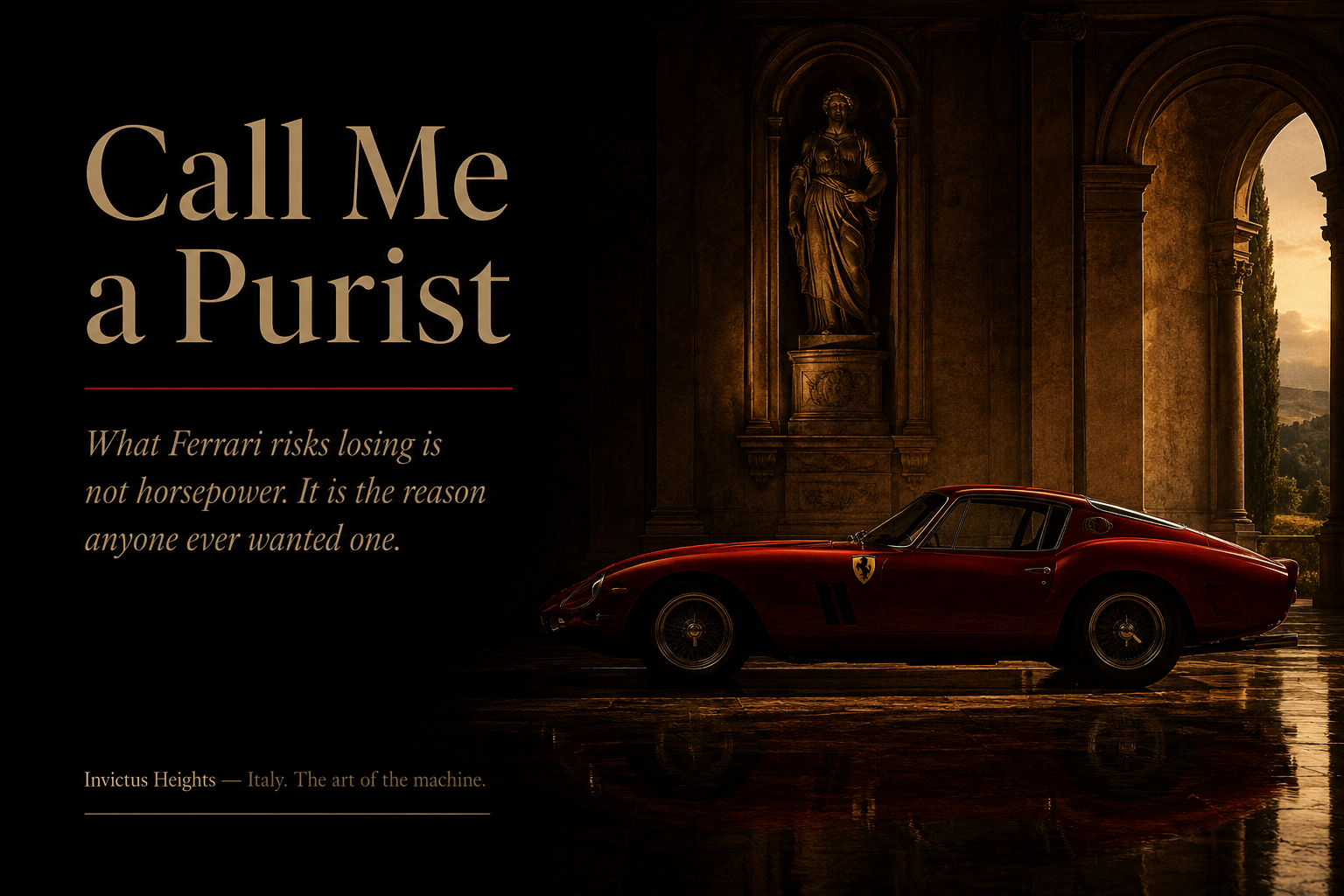
Call me a purist.
Written by Emanuela Petrelli
Emanuela Petrelli is the founder of Invictus Heights, a house preserving automotive culture through art, editorials and collector objects. She curates GTO Circle, a Ferrari community of owners and enthusiasts, and writes on cars and marques through the lens of brand, meaning and design.


Leave a comment
This site is protected by hCaptcha and the hCaptcha Privacy Policy and Terms of Service apply.