


Article: Call Me a Purist
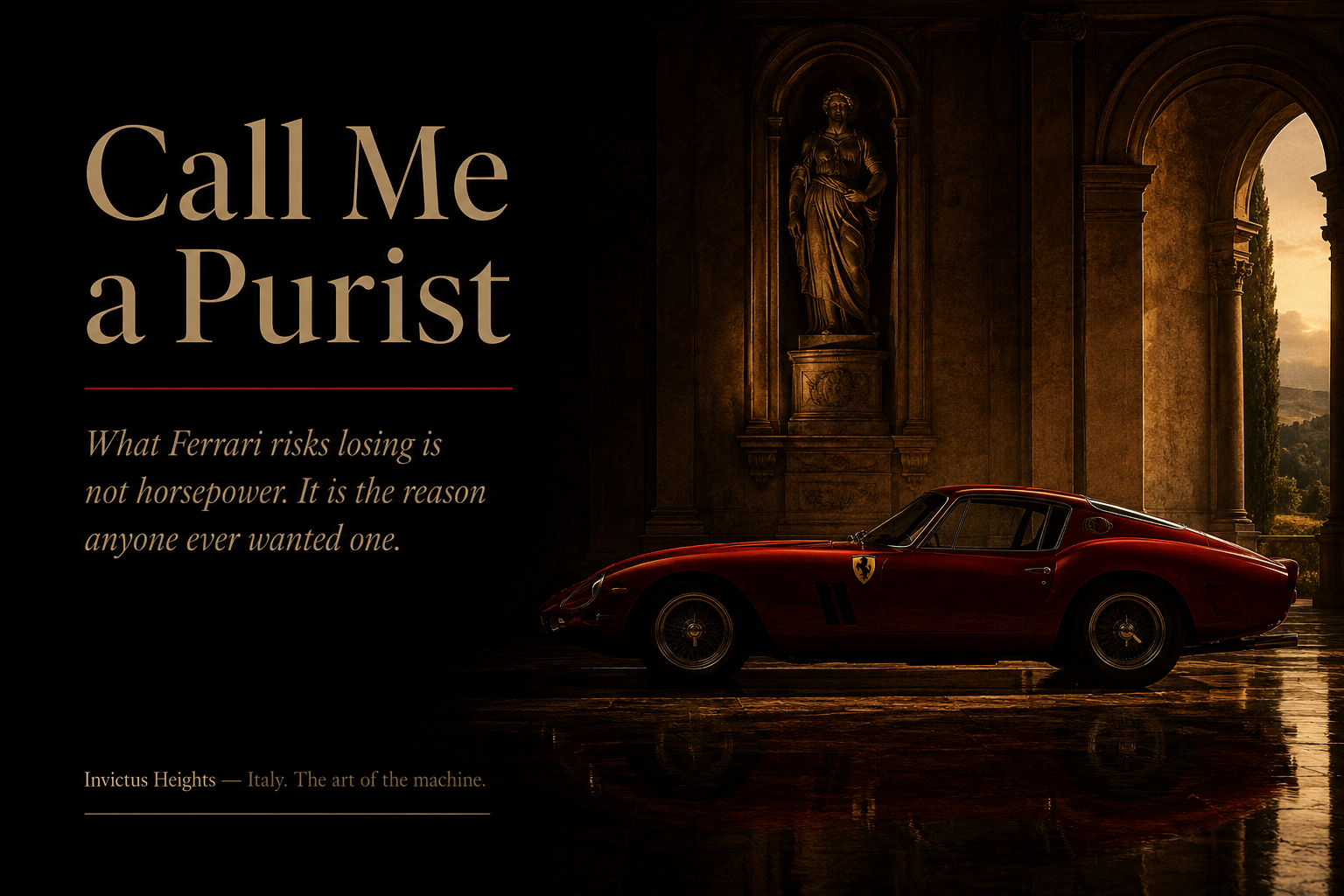
Call Me a Purist
What Ferrari risks losing is not horsepower. It is the reason anyone ever wanted one.
In the first part of this reflection on the Ferrari Luce, I wrote about language — about what happens when a car cannot be called beautiful, and is called brave instead. But another word moved just as quickly through the conversation.
Purist.
It appeared almost immediately. As soon as people recoiled from the Luce, the label was ready: purist, nostalgic, narrow, afraid of change, unable to understand that Ferrari must move with the world. It is a convenient word, because it ends the discussion before the discussion has begun. Once someone is called a purist, their objection no longer needs to be answered.
So fine. Call me a purist.
But before we use that word as an insult, we should ask who, in this conversation, is actually being pure. Is the purist the one who questions a Ferrari that no longer feels like Ferrari? Or the one who accepts anything Maranello proposes, because the badge alone is enough? That is the question. And it matters more than the Luce itself.
This is not nostalgia
When the Luce was revealed, I could have posted it on GTO Circle and joined the rage. I did something else. Instead of entering the noise, I tried to return to the beginning.
Ferrari did not begin as a marketing idea. It did not begin as a lifestyle house. It did not begin as a logo to be applied to anything expensive enough to carry it. It began with racing. In 1929, Enzo Ferrari founded Scuderia Ferrari as a racing team. The road cars came later. The myth came later still. The order matters.
Ferrari raced. Racing created proof. Proof created desire. Desire created scarcity. Scarcity became myth.
The scarcity was not the original strategy. It was the consequence of wanting something that had proved itself first. That is why Ferrari has never been only a car company. It became something harder to build: closer to a belief system, almost a religion. A world people wanted to enter, even when they knew they probably never would.
That helps explain the reaction around the Luce. It is not only that people disliked a car. It felt, to some, as if the thing they believed in had asked them not to believe anymore. So when people say, “it is only a car,” they miss the point.
It was never only a car.
The people without keys matter too
There is a strange argument that appears whenever Ferrari is criticised from the outside: if you cannot afford one, you have no right to an opinion. It sounds practical. It is not.
Ferrari has never belonged only to the people who own one. The ownership circle is small, by design. But the desire around Ferrari has always been much larger than the ownership circle. That wider desire is not irrelevant. It is the atmosphere that makes ownership meaningful.
The boy with the poster mattered. The person who stopped walking when a Ferrari passed mattered. The enthusiast who knew the chassis numbers, the race histories, the liveries, the sound of one model from another — they mattered.
Anyone who has built or watched a Ferrari community understands this. Remove the enthusiasts, and what remains around the car? How much of the desire around ownership exists because thousands of people without the keys still care enough to look, photograph, comment, share, remember? Not because an owner needs likes. Because owning a car that the world still wants is not the same as owning a car nobody looks at twice.
A Ferrari owner may own the car, but the fascination around that car is carried by many more people. The people who may never buy the car helped build the mythology that made the car worth buying.
A Veblen good does not live only from possession. It lives from recognition. The owner enjoys the privilege because the world still understands what the privilege means. If the world stops wanting in, the circle becomes only a room.
That is why non-owners have a voice in this conversation. Not because they will buy the Luce. Most will not. But because their desire, their memory, their longing and their recognition are part of the value Ferrari has accumulated over decades.
The dream is not outside the market. The dream is the foundation.
It is possible to love Ferrari and not love everything Ferrari does
This should be obvious, but somehow it no longer is. To love a marque does not mean applauding every decision made by the people currently managing it. A brand is not its management. A badge is not every product carrying it. A myth is not automatically protected by the company that owns the trademark.
Sometimes the people who love a marque are the first to see when something begins to shift. That is not disloyalty. It is attention. There is a difference between criticism from distance and criticism from care. One wants to win an argument. The other wants the thing to remain worthy of itself.
And the most serious version of that care does not come from outside the gates. Luca Cordero di Montezemolo ran Ferrari for twenty-three of its greatest years. He looked at the Luce, said he was sorry to say it, warned that a myth was being put at risk — and then said the hardest thing a former chairman can say about a car still in the showroom: that they should, at the very least, take the Cavallino off it. When the man who guarded the badge for two decades tells you to remove it, that is not disloyalty. It is the deepest form of loyalty there is.
The Ferrari Luce has revealed this difference very clearly. Some people rejected it because it was electric. That is the easy criticism, and perhaps the weakest one. An electric Ferrari was always coming. The world changes, regulations change, technology changes. No serious argument can pretend otherwise.
But the deeper resistance was never only about electricity. It was about meaning. It was about looking at a Ferrari and feeling that the reflection had changed.
A brand is a mirror
A great brand is never only about the product. It is about recognition. People do not attach themselves to brands because of features alone. They attach themselves because the brand reflects something back to them — who they are, who they want to become, what they believe they belong to.
Ferrari has always done this with unusual force. You do not simply buy a Ferrari. You buy into a version of yourself: faster, sharper, rarer, more alive, closer to risk, closer to beauty, closer to the track even when you are on the road. In Italian, we almost say it without theory. Not only avere una Ferrari. Essere Ferrari. To be Ferrari.
That is the power of the marque. It is not the object alone. It is the identity the object allows a person to recognise. A great brand is a mirror held at exactly the right angle. The more precise the reflection, the stronger the bond.
So the danger is not that Ferrari changes. A brand can change shape, technology, proportion and category. The danger is that the mirror begins to show a different face. That is where the Luce becomes important.
Not because it is the first Ferrari to divide opinion. Ferrari has divided opinion before. In fact, perhaps this is one of the least divided Ferrari conversations in recent memory: the defence exists, but it feels small compared with the discomfort around it.
But because for many people who love the marque, the Luce does not simply change the expression. It seems to change the person reflected in the glass: a more technological person, whose status comes less from fire, sound, speed, risk, beauty and performance, and more from being early to the next expensive object. A person who may want Ferrari as access, as signal, as innovation — but not necessarily as a car, in the deepest sense of the word. A person who may not even really like cars.
That may be a customer. But is it Ferrari’s customer? Or is it someone Ferrari has decided to court while asking the old faithful to move aside quietly?
This is where the contradiction becomes difficult to ignore. The Luce has remarkable performance. It has five seats. It enters a category that is hard to read and harder to place. It is not quite a supercar, not quite a grand tourer, not quite an SUV, not quite a limousine. And yet, for all its numbers, it does not carry the immediate fascination, the sensuality, the attraction, the physical tension people expect from a Ferrari.
So what is being sold? Not the engine. Not the classic supercar dream. Not the emotional violence of a shape that makes you stop breathing for a second. What seems most attractive here is the technology. And if technology becomes the centre of the offer, then the question changes. Ferrari is no longer selling a car with technology inside it.
It is selling technology with Ferrari around it.
That is a very different business.
Change the expression. Protect the meaning.
This is the line. A brand that refuses to change becomes a museum of itself. I am not interested in defending a Ferrari trapped in amber. Ferrari has always evolved. Front-engined cars, mid-engined cars, grand tourers, racing prototypes, limited series, hybrids, one-offs. Evolution is part of the story.
But evolution has a standard: change the expression, protect the meaning. That is what strong brands do. They do not repeat the past mechanically. They translate the core into a new form.
The Purosangue is useful here, because it is the example many defenders reach for. The faithful said an SUV could never wear the badge. Then the car arrived, and many accepted it. Why? Not because everyone suddenly stopped caring. Not because the criticism was stupid. But because, in the end, the Purosangue still carried enough Ferrari in its body. It was an unfamiliar format, but the emotional code was still visible: the posture, the aggression, the elegance, the sense that the car still wanted something from the road.
The mirror was held at a strange angle, but many could still recognise the face.
The Luce does something different. It does not only move Ferrari into a new technology. It moves Ferrari toward a different emotional code. It asks the badge to do the work that the object itself should have done. That is the problem.
A badge can confirm meaning. It should not have to create it from nothing.
Ferrari has lived this lesson before, and it came from the founder himself. When Enzo built a smaller, more reachable car, he did not put the Prancing Horse on it and trust the badge to carry it. He gave it its own name — Dino, after his late son. A new car, a new audience, a new price, and a separate badge, precisely so the Ferrari name was never asked to mean something it did not. That was not caution. It was brand architecture, taught by the man who built the brand. Reaching new people was never the danger. Spending the name to do it was.
What is this, exactly?
A niche means knowing what you are here to do, and doing that one thing with unusual force. Ferrari’s one thing was never only transport. It was never only luxury. It was never only speed. It was engine, racing, performance, beauty, danger, desire — brought together in a machine that could not be mistaken for anything else.
Engines first. Supercars second. Myth after that.
Here, the order is harder to read. There is no engine at the centre. There is no classic supercar form. There is no immediate seduction of proportion, sound, aggression and stance. There is performance, yes. But performance without emotional authority becomes a number. And Ferrari was never loved only for numbers.
So where does the Luce belong exactly? If it is not the engine dream, not the supercar dream, not the racing dream, not the poster dream, then what is it?
That is not a rhetorical question. It is the whole problem.
The missing wow
Perhaps this is why the reaction feels so deep for those of us who grew up with Ferrari. I grew up with new Ferrari reveals creating a moment. A wow moment. That first instinctive feeling of: there it is.
Not because every Ferrari had to be classically beautiful, and not because every Ferrari had to please everyone. Some were difficult. Some were extreme. Some took time. But even when they were difficult, they carried that charge. They had presence. They made the room change temperature.
I miss that feeling. And I do not think I am alone.
Maybe the question Ferrari should be asking is not only how to reach new customers. Maybe it should also ask why some of the people who already love Ferrari no longer feel that immediate sense of wonder when a new car appears. Because if the faithful have to be convinced, explained, educated and reassured every time, something has already shifted.
A press release can explain a strategy. It cannot create wonder.
The false comfort of “they will still build the real ones”
One of the most common replies is simple: do not worry, Ferrari will still build combustion cars. The V12 will continue. The special cars will continue. The real Ferraris are not disappearing. But this misses the point.
The Luce was never going to replace the V12 directly. That is not where the damage sits. The issue is not replacement. It is dilution. The badge sits on all of it.
If the badge begins to mean too many different things, then every car carrying it inherits that widened meaning. You cannot protect the soul in one room while spending the name in every other. A Ferrari V12 does not exist in isolation from the rest of Ferrari. It is strengthened or weakened by what the whole marque means.
That is why people react so strongly. They are not only reacting to one car. They are reacting to what one car suggests about direction. They are asking: what will Ferrari mean to the next person who discovers it? Engine? Racing? Beauty? Risk? Sound? Or simply luxury technology with the Prancing Horse badge?
That question deserves more than dismissal.
If it sells, the problem does not disappear
The real drama is not that the Luce may fail. The real drama is that it will sell.
If it failed, Ferrari could archive it as a mistake. A wrong turn. A brave attempt that did not land. The market would correct the direction, forget about it, and the company could move on. But when it sells, the mistake becomes harder to name. It becomes a direction.
That is the danger of a badge as powerful as Ferrari’s. It can move a product even when the product does not strengthen the myth. It can create orders before it creates conviction. And once the orders arrive, the sale itself becomes the argument.
See? The market wanted it.
But the market is not always measuring meaning. Sometimes it is only measuring access, pressure, allocation, loyalty, status, or the simple fact that certain clients can afford to say yes without consequences.
A car can sell and still weaken the thing that sold it. That is the uncomfortable part.
The favour collectors think they are doing
This is where the role of major collectors becomes delicate. Many of them will buy the Luce. Some because they are curious. Some because the cost does not change their life. Some because they want to maintain their place in the Ferrari ecosystem. Some because Ferrari asked, and when Ferrari asks, saying no may feel complicated. Some will also defend it.
But here is the uncomfortable point: this car may not have been made for them. Not really. It may have been made for a different client, a different psychology, a different idea of status — while relying on the loyalty of existing collectors to legitimise it.
And perhaps some will buy it as a favour to the brand. But is it really a favour to the brand? Or is it a favour to the management currently steering it? That distinction matters.
Because buying every direction Ferrari proposes may feel like loyalty in the moment, but loyalty without judgement can become dangerous. A marque does not only need clients who say yes. It also needs people close enough, invested enough, and serious enough to say: this does not feel right.
Otherwise the brand receives the wrong lesson. Not that the object was loved. Only that it was bought.
And this is where, as Italians, the concern becomes familiar. We have seen too many great names lose gravity when they are treated first as assets, and only later as culture. Ferrari cannot become the next.
How many times can collectors do that before the relationship changes? How many times can desire be replaced by obligation before even the faithful begin to feel less like believers and more like participants in a system?
And there is a reason this keeps happening — one that goes beyond any single car or any single decision. It is the quiet logic of a company that now answers to a market, and a market wants growth without end. That machine, and what it is doing to the marque, is the subject of the final part of this series. For now it is enough to name what it does: it asks the badge to carry more and more, until the badge risks meaning less and less.
So who is the purist?
This is where the word needs to be turned around. If being a purist means refusing every change, then no. That is not the argument. If being a purist means believing Ferrari should only build cars that look like they came from the 1960s, then no. That is not the point.
But if being a purist means believing that a marque should remain faithful to the meaning that made it worth loving, then perhaps the word is not an insult. Perhaps it is a responsibility.
And perhaps the real purist is not the person questioning the Luce. Perhaps the real purist is the person who treats the badge as sacred only when management places it there. The person who accepts every product, every direction, every justification, because to question Maranello feels like betrayal.
That is not loyalty. That is obedience.
Loyalty has a spine. Obedience only has a reflex.
To love Ferrari seriously is not to say yes to everything. It is to hold the marque to the standard it created for itself: the standard of racing, the standard of beauty, the standard of desire, the standard of meaning.
Ferrari made people believe those standards mattered. It cannot be surprised when those same people still do.
In defence of Ferrari, not against it
This is written because Ferrari matters. If it did not matter, no one would care. No one would argue. No one would write. No one would feel that strange mix of anger and sadness that appears when something loved begins to speak in a different voice.
Indifference is quiet. Love is not.
The people who criticise the Luce from a place of care are not trying to destroy the marque. They are trying to name the moment before it passes unchallenged. That is why criticism matters. It slows down the easy story. It refuses to let commercial success become the only proof of correctness.
It says: yes, the car may sell. Yes, the orders may arrive. Yes, the badge is powerful enough to move almost anything. But selling is not the same as meaning. And meaning is the thing Ferrari cannot afford to lose.
Because what Ferrari risks losing is not horsepower. It is the reason anyone ever wanted one.
Call me a purist
So yes. Call me a purist.
I will take the word if it means believing that Ferrari is more than the sum of the things it can sell. I will take it if it means believing that innovation should serve identity, not replace it. I will take it if it means defending the dream as much as the car.
Because the dream came first for almost everyone. Before the keys. Before the allocation. Before the garage. Before the invitation.
There was a sound, a shape, a poster, a race, a colour, a story. There was the impossible feeling that one machine could hold beauty, danger, speed and memory at the same time.
That is what Ferrari built. That is what people protect. And that is why the question remains.
Who is the purist? The one who looks at a Ferrari and dares to say that something essential is missing? Or the one who sees the badge, stops thinking, and calls that loyalty?
I know where I stand. Call me a purist.
Some things are not for sale.

Written by Emanuela Petrelli
Emanuela Petrelli is the founder of Invictus Heights, a house preserving automotive culture through art, editorials and collector objects. She curates GTO Circle, a Ferrari community of owners and enthusiasts, and writes on cars and marques through the lens of brand, meaning and design.


Leave a comment
This site is protected by hCaptcha and the hCaptcha Privacy Policy and Terms of Service apply.