


Article: Porsche Mission S: The Future Has a Memory
Porsche Mission S: The Future Has a Memory
Unveiled in October 2026, the Porsche Mission S introduces a new mid-engined supercar vision, combining historic design, analogue driving and an ambitious plan to expand the Porsche range beyond the 911.
A New Chapter, Written in Familiar Lines
On 15 October 2026, Porsche unveiled the Mission S in New York, introducing a concept car that offers an early glimpse into the future of the German sports car manufacturer.
Developed as part of Sportwagenschmiede ’35, Porsche's strategic realignment, the Mission S represents more than an evolution of the brand's design language. It introduces the foundations of a new mid-engined super sports car platform, positioned above the 911 and intended to become a permanent addition to the Porsche portfolio.
This distinction is important.
Throughout its history, Porsche has created extraordinary machines that have stood apart from its regular production range. The Carrera GT and the 918 Spyder, for example, represented exceptional moments in the company's engineering evolution, each with its own technical identity and limited production life.
The Mission S points towards something different: a continuing supercar offering, rather than another isolated chapter.
Porsche CEO Michael Leiters describes the concept as an indication of the design ideas and characteristics that will shape the company in the coming years.
It is an ambitious direction, but one that begins with a familiar principle: a Porsche must remain immediately recognisable as a Porsche.
And that is precisely where the Mission S becomes interesting.
From the Porsche 550 Spyder to the Mission S: Seventy-Three Years of Heritage

Porsche chose a remarkably meaningful location for the Mission S world premiere.
In 1953, photographs of the Porsche 550 Spyder were taken on a pier in Queens, New York, with the Manhattan skyline in the background. Those images travelled around the world, helping introduce the young German manufacturer to an international audience, particularly in the United States.
Seventy-three years later, Porsche returned to the same location to introduce its vision of the future.
The symbolism was deliberate.
The 550 Spyder was a defining automobile in Porsche's early sporting history. Its compact dimensions, lightweight construction and mid-engined architecture expressed a philosophy in which engineering efficiency and driving precision were inseparable.
The Mission S returns to that architectural principle, although on an entirely different scale.
By placing the engine centrally, Porsche is once again exploring the proportions and dynamic possibilities that have historically distinguished some of its most significant competition and road cars.
The New York presentation was therefore more than an exercise in nostalgia.
It established continuity between two distinct moments in the company's history, suggesting that the next generation of Porsche supercars will be developed with a clear understanding of the principles that shaped the brand.
Porsche Mission S Design: A Contemporary Interpretation of Historic Icons

Under the design direction of Tobias Sühlmann, Vice President Style Porsche, the Mission S introduces a sculptural interpretation of the company's established visual language.
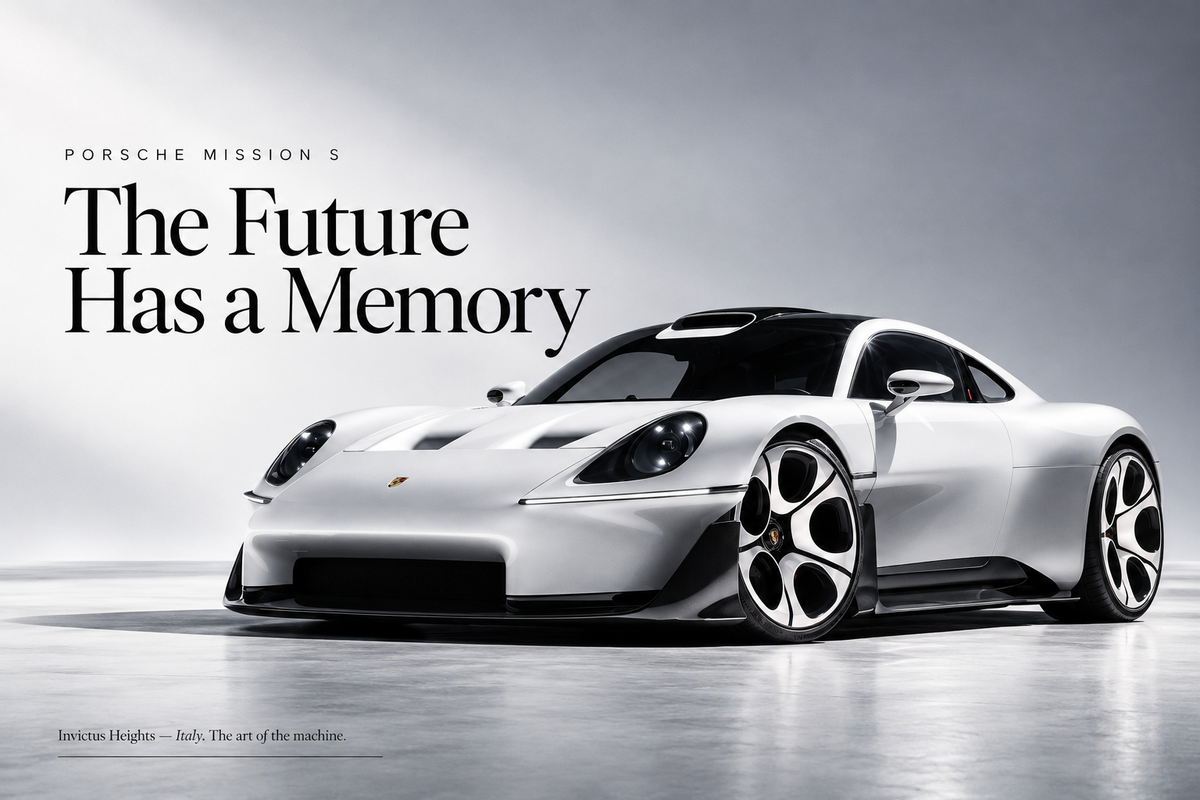
The proportions immediately communicate its mid-engined configuration: a low silhouette, pronounced wheel arches, a broad stance and a roofline that flows towards the rear.
Rather than relying on decorative complexity, the bodywork is organised around clearly defined volumes and surfaces.
Porsche describes these forms as floating volumes, an approach that combines flowing exterior shapes with a more technical treatment of the lower sections of the vehicle.
A continuous visual line connects the front and rear lighting signatures, creating a sense of unity across the body.
Several historical Porsche models have contributed to the design.
The rounded headlights and prominent front fenders recall the 911, while details of the lighting and panel intersections reference the classic G-series.
The flattened front section draws inspiration from the Porsche 911 GT1, a machine whose architecture was determined by the demanding relationship between road-car homologation and endurance racing.
The roofline introduces another connection, this time to the Porsche 959, extending towards the rear of the Mission S beneath its integrated aerodynamic elements.
At the back, Porsche revisits the GT1's distinctive car-in-car design approach, in which the central structure appears visually separated from the surrounding bodywork.
The cooling arrangement also carries a reference to the legendary Porsche 917, with a design inspired by its characteristic horizontal fan.
Even the wheels contribute to this historical dialogue.
Their graphic treatment is derived from the distinctive dial-style wheels of the Porsche 928, reinterpreted through a lightweight construction philosophy.
Together, these references form something more substantial than a collection of familiar shapes.
Each historical element has been adapted to a contemporary design, preserving recognition while allowing the vehicle to establish its own identity.
The result is a concept that communicates a remarkable amount of Porsche history without presenting itself as a retro design exercise.
Porsche Mission S Engine: V8, V6 or Hybrid?
One of the most intriguing questions surrounding the Porsche Mission S concerns its powertrain.
While Porsche has confirmed that the concept introduces a new mid-engined super sports car platform, the company has not yet disclosed definitive engine specifications.
There is currently no official confirmation of a V8, V6, flat-six or any other engine configuration. Displacement, power output, transmission and acceleration figures also remain undisclosed.
The possibility of a high-performance combustion engine, potentially supported by hybrid technology, naturally invites speculation. Porsche has considerable experience in both traditional sports car engineering and electrified high-performance powertrains, most notably demonstrated by the 918 Spyder.
However, the Mission S announcement does not establish which technical solution will ultimately reach production.
What can be examined is the philosophy behind the architecture.
A centrally positioned engine offers different possibilities for weight distribution, vehicle balance and packaging compared with the rear-engined layout that has defined the Porsche 911 for generations.
The Mission S also incorporates visible technical features that suggest the importance of thermal management, aerodynamic efficiency and lightweight construction.
Its cooling solution, inspired by the Porsche 917, integrates a historical engineering reference into a contemporary design. The fully integrated active rear wing adds another functional element, demonstrating how aerodynamics and exterior styling have been developed together.
These features reveal the technical ambitions of the concept, even if its final mechanical configuration remains unknown.
For enthusiasts, the choice of powertrain will be especially significant.
It will help determine not only the performance character of the future Porsche supercar, but also the way in which the driver experiences sound, response, acceleration and mechanical feedback.
The Mission S has already established its architectural identity. Its mechanical personality is still waiting to be revealed.
Porsche Mission S Interior: The Driver Returns to the Centre
Perhaps the most culturally significant aspect of the Mission S is found inside.
For years, the automotive industry has progressively introduced larger displays, increasingly complex digital interfaces and software-driven controls.
The Mission S proposes a different balance.
Its interior draws inspiration from the Porsche 356 and 550 Spyder, with a cockpit architecture intended to place the driver deep within the vehicle.
Two principal design lines extend through the dashboard and doors, visually connecting the occupants to the structure of the car.
The approach is deliberately restrained.
Physical switches and buttons remain part of the interaction, complemented by digital functions where they provide a practical advantage.
The five traditional circular instruments return behind the steering wheel, preserving one of Porsche's most recognisable interior signatures.
At their centre sits a rev counter with an analogue needle and a digital display positioned behind it.
The instrument cluster is not entirely static.
Depending on the selected driving mode, the rev counter can move towards the driver, while the other instruments change their relative positioning to prioritise relevant information.
This is an interesting interpretation of modern technology: rather than removing familiar mechanical interfaces, Porsche is using innovation to reinforce their purpose.
The Sport Chrono element follows a similar philosophy, combining analogue character with digital precision.
And then comes one of the Mission S's most distinctive decisions.
There is no permanently integrated central infotainment screen.
Instead, Porsche has developed a retractable smartphone holder compatible with MagSafe technology, allowing the driver's own device to provide navigation and other information when required.
The My Porsche app provides access to vehicle functions, while digitally rendered instrument designs offer additional possibilities for personalisation.
The absence of a permanent central display changes the visual hierarchy of the interior.
The driver's attention returns to the steering wheel, the instruments and the road ahead.
Technology remains available, but it no longer dominates the cockpit.
Even the placement of the key follows Porsche tradition.
Positioned to the left of the steering wheel, it preserves a small but recognisable ritual associated with the brand's sporting history.
New push-pull controls offer direct access to driving and comfort functions, while the seats incorporate modern ergonomic solutions, including a seatbelt buckle integrated into the central panel.
The interior colour palette also reflects Porsche's motorsport heritage, combining Firn White Metallic, Light Red Metallic, Black Chrome and Special Black.
White, grey and red recall the visual identity of historic racing Porsches, adapted to the restrained environment of the Mission S.
The concept offers an important reminder: technological progress does not necessarily require the elimination of familiar gestures.
Sometimes, innovation consists of making those gestures more meaningful.
Beyond the Porsche 911: A Permanent Supercar Family
The Mission S occupies a particularly important position in Porsche's future product strategy.
For decades, the Porsche 911 has represented the central reference point of the company's sports car portfolio, continually evolving while preserving its distinctive rear-engined architecture.
Porsche has occasionally moved beyond that formula through extraordinary projects such as the Carrera GT and the 918 Spyder.
Those vehicles demonstrated what the company could achieve when exploring different engineering architectures and performance objectives.
The Mission S introduces the possibility of making that territory a permanent part of the business.
Rather than developing another exclusive hypercar with a defined production cycle, Porsche is planning an ongoing family of mid-engined super sports cars positioned above the 911.
The distinction could have considerable implications for future product development.
A dedicated platform may provide greater freedom to explore engineering solutions, different vehicle configurations and a broader range of performance characteristics.
It may also offer Porsche an opportunity to establish a more consistent presence in the highest segment of the sports car market.
Porsche Mission S Production, Price and Release Date
Despite the strategic importance of the announcement, Porsche has not yet confirmed a production launch date, final pricing, production volumes or the definitive specifications of the future models.
The Mission S remains a vision model, rather than a production-ready automobile.
Its final commercial positioning will therefore depend on decisions that have yet to be publicly detailed.
What Porsche has confirmed is the intention to establish a permanent super sports car offering above the 911, supported by a new mid-engined platform.
The Mission S is therefore both a design statement and an indication of long-term industrial ambition.
Its significance will ultimately depend on how successfully Porsche translates this vision into production automobiles.
But the direction is clear: the company intends to extend its sports car hierarchy while preserving the engineering principles that define its identity.
Invictus Heights | Editorial Perspective
Porsche, Ferrari and a New Position in the Supercar Landscape
There is another dimension to the Mission S announcement that deserves consideration.
Michael Leiters, who became CEO of Porsche in January 2026, brings an unusual combination of experience to this moment.
Before returning to Porsche, he spent more than eight years as Chief Technology Officer at Ferrari, followed by a period as CEO of McLaren Automotive.
His professional experience therefore extends across three manufacturers with distinct approaches to performance, engineering, brand identity and customer expectations.
That background makes Porsche's decision to establish a permanent supercar offering above the 911 particularly interesting.
Ferrari has long demonstrated the commercial and cultural strength of a business built around high-performance cars, personalisation, exclusivity and a powerful connection with collectors.
Porsche, meanwhile, has traditionally combined a broader production portfolio with an exceptional sporting identity, supported by generations of engineering development and motorsport success.
With the Mission S, those two approaches may begin to occupy more closely related territory.
It would be premature to describe this as a direct challenge to Ferrari, particularly while the final specifications, pricing and production strategy remain undisclosed.
Yet the strategic direction invites comparison.
A permanent Porsche supercar family could offer collectors and high-performance enthusiasts another proposition in a segment where engineering distinction, heritage and ownership experience carry considerable weight.
There is also an intriguing philosophical direction emerging from the Mission S.
Porsche is placing particular emphasis on analogue interaction, visual restraint and a stronger relationship between driver and machine.
These choices may resonate with enthusiasts who increasingly value the sensory and mechanical dimensions of the driving experience.
Whether that philosophy becomes a meaningful commercial advantage remains to be seen.
What is certain is that Porsche is preparing to expand its ambitions beyond the traditional boundaries of the 911.
And under the leadership of someone who understands Ferrari, McLaren and Porsche from the inside, this next chapter deserves close attention.
The Mission S may ultimately be remembered for more than the supercar it anticipates. It could mark the moment Porsche began redefining its place at the very top of the sports car world.
Source: Porsche AG, “Porsche Mission S: The Essence of the Sports Car Reinterpreted”, 15 October 2026; Porsche AG, “Dr. Michael Leiters Will Become CEO of Porsche AG”, 17 October 2025.
The final section represents independent editorial analysis by Invictus Heights.

Written by Emanuela Petrelli

Leave a comment
This site is protected by hCaptcha and the hCaptcha Privacy Policy and Terms of Service apply.