

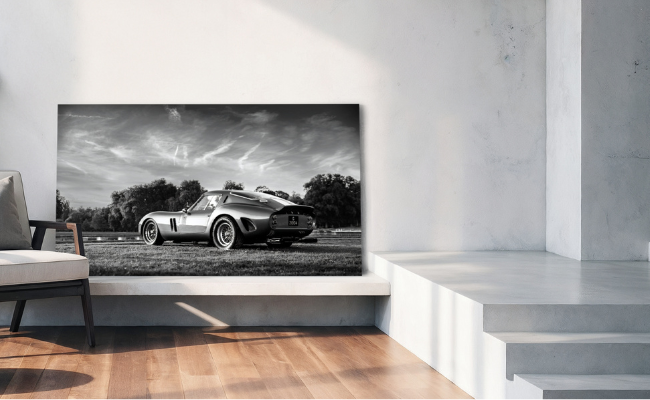

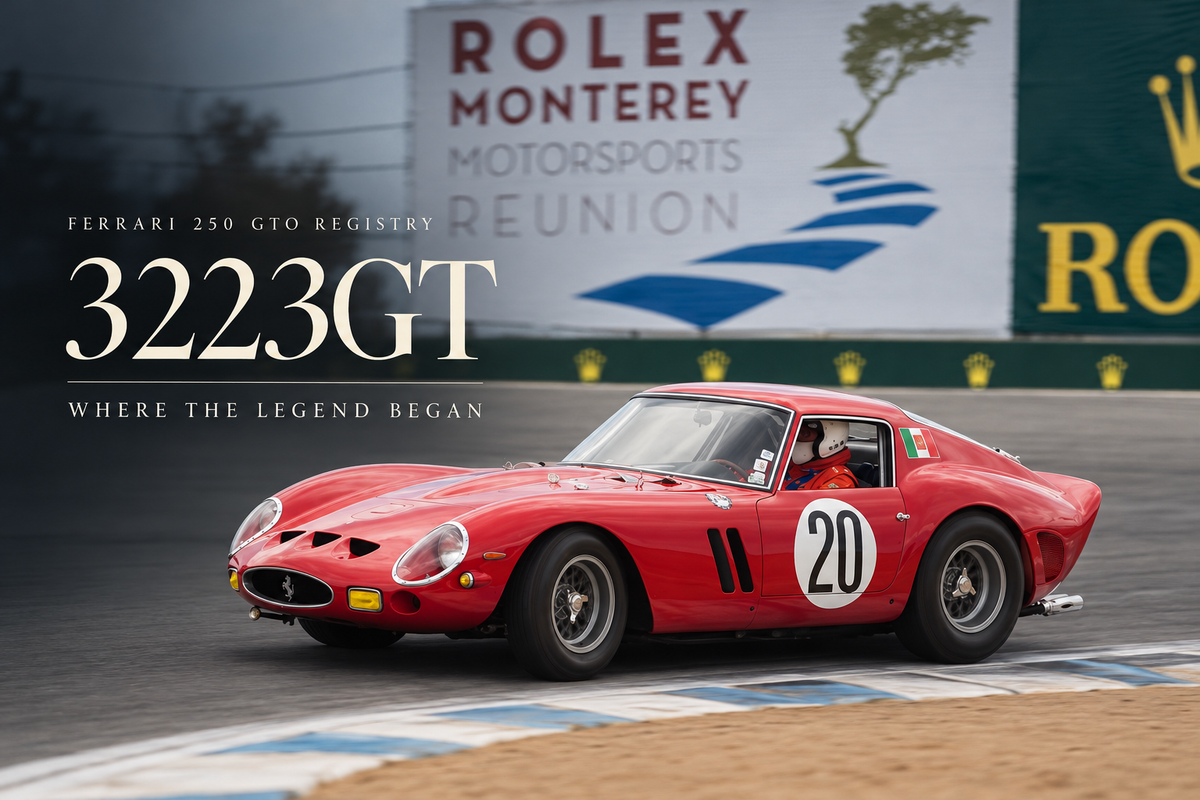
Article: Ferrari 250 GTO Registry | 3223GT — Where the Legend Began
Ferrari 250 GTO Registry | 3223GT — Where the Legend Began
The first of thirty-six. From Ferrari's development programme in Maranello to the American racing circuits, the story of the chassis that witnessed the birth of a legend.
Before the legend had a name
On 24 February 1962, Ferrari presented its new competition berlinetta to the international press at Maranello.
Its long, low nose, sculpted aluminium body and distinctive proportions already suggested something extraordinary. Yet the car standing in the factory courtyard was still evolving.
The rear spoiler, now one of the defining elements of the 250 GTO silhouette, was missing. Other details would undergo further refinement as Ferrari continued to develop its new Grand Touring machine.
The car presented that day is widely identified by historians as chassis 3223GT.
Today, the Ferrari 250 GTO is recognised as one of the most significant automobiles ever created. In February 1962, however, its purpose was considerably more immediate: to become Ferrari's next great weapon in international Grand Touring competition.
And 3223GT was where that journey began.
A car born from development
The 250 GTO emerged from Ferrari's determination to take the already successful 250 GT Berlinetta SWB to another level.
Giotto Bizzarrini played a central role in its early development, working on the chassis, mechanical configuration and aerodynamic solutions that would distinguish the new competition car.
Following his departure from Ferrari in 1961, Mauro Forghieri helped bring the project to completion, while Sergio Scaglietti translated the engineering requirements into remarkably elegant aluminium bodywork.
Beneath the new silhouette remained a clear connection to the 250 GT bloodline.
A tubular steel chassis, a 2,400 mm wheelbase and a front-mounted, three-litre V12 provided the foundation. Fed by six Weber carburettors and paired with a five-speed manual gearbox, the engine produced approximately 300 horsepower.
But power alone was never the answer.
Aerodynamics, weight distribution, stability and mechanical reliability were equally important. The engine was positioned further back within the chassis, the bodywork was shaped to reduce drag, and the overall structure evolved around the demands of high-speed endurance racing.
Development of 3223GT was underway by late 1961. The car was extensively tested before the factory released it for private competition.
It was a machine still being understood, measured and improved.
This is what makes the first chassis particularly fascinating. Its historical importance lies not only in being first, but in having participated directly in the process that defined every GTO that followed.
From Maranello to America
Although 3223GT was the first completed GTO, it was not the first to compete.
Ferrari retained the car for development and promotional duties while other chassis began their racing careers. In June 1962, it was delivered to Luigi Chinetti during the Le Mans meeting, where it remained as a spare, before travelling to the United States.
Its first private owner was William McKelvy of Pittsburgh, whose Scuderia Bear would campaign the car. Historical records place the purchase in July 1962, at a price of $18,500.
From that moment, the first GTO began building an identity beyond the factory gates.
Its competition debut came at the Bridgehampton 400 Kilometres on 16 September 1962.
Driven by Charlie Hayes and Ed Hugus, chassis 3223GT finished third overall.
It was an encouraging beginning.
Later that year, the car travelled to the Bahamas for Nassau Speed Weeks, where it competed under the North American Racing Team banner.
Among the drivers entrusted with the car was Lorenzo Bandini, who finished second overall in the Nassau Tourist Trophy.
Charlie Hayes also achieved strong results during the meeting, including victories in the three-litre GT class.
The first GTO was no longer a development machine displayed at Maranello.
It had become a genuine competitor.
Colours that tell a story
Like many competition Ferraris of its period, 3223GT did not retain one visual identity throughout its racing life.
Historical records document the car in different liveries and configurations, including grey with white detailing during early American competition, metallic blue with white markings, and later red with white accents.
These changes were more than cosmetic.
Colours, race numbers, sponsor markings and mechanical modifications reflected the different owners, drivers and championships that shaped its life.
During the following seasons, the car competed at Daytona, Sebring, Marlboro, Bridgehampton and Mosport.
Drivers included Charlie Hayes, Bob Grossman, Fireball Roberts, Bill Eve and Larry Perkins.
Each represented another chapter in the history of a machine that moved between professional racing ambitions and the demanding world of private entrants.
And like all racing cars of the period, 3223GT evolved through use.
One particularly unusual detail emerged during Larry Perkins' ownership.
Following repairs to the front bodywork, parking lights from a Porsche 356 were incorporated into the Ferrari.
It was a practical solution born from the realities of maintaining a competition car thousands of kilometres from Maranello, with limited access to replacement parts.
Today, such a detail might appear extraordinary on a Ferrari of this importance.
In period, it was simply part of keeping the car racing.
The privateer years — when determination mattered as much as horsepower
By 1964, chassis 3223GT was in the hands of American racer Larry Perkins.
His experience with the car offers a particularly revealing glimpse into the world of private motorsport during the 1960s.
Preparing for the Daytona 2000 Kilometres, Perkins needed sponsorship.
He found support from Al Hodges, a local Pontiac dealer who agreed to help finance the effort in exchange for displaying the Ferrari alongside a Pontiac GTO in his showroom.
Two entirely different interpretations of the letters GTO were temporarily sharing the same commercial space.
The arrangement even resulted in the Pontiac dealership's name appearing on the Ferrari's bodywork.
According to Perkins' later recollections, Luigi Chinetti was deeply unhappy about the advertising. Perkins eventually sought the opinion of Bill France, the influential founder of NASCAR, whose position was rather more pragmatic: the sponsor financing the race deserved recognition.
The story is a small but revealing example of the culture surrounding these cars.
For a private entrant, competing required far more than owning a fast Ferrari.
It demanded connections, imagination, mechanical knowledge and an extraordinary determination to keep racing.
At Daytona in 1964, Perkins and Bill Eve finished eleventh overall despite electrical problems that required a lengthy repair.
A few weeks later, they competed again at Sebring.
Even as the 250 GTO's position at the forefront of GT racing began to change, the first chassis continued to prove its endurance.
Daytona 1966 — the first GTO still had something to prove
By 1966, the international motorsport landscape had changed dramatically.
More advanced racing machinery was dominating the headlines, and the original 250 GTO was no longer at the forefront of technological development.
Yet 3223GT was still competing.
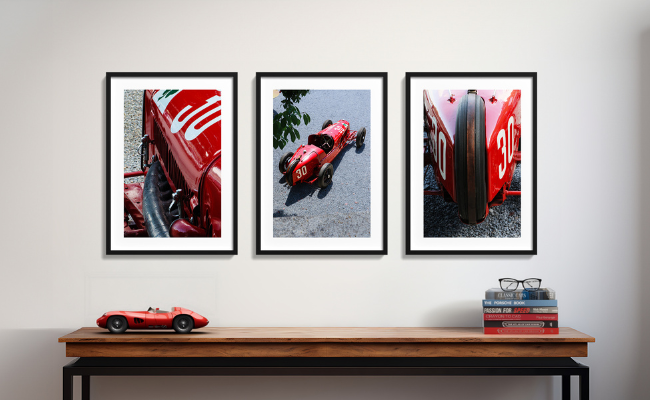
For the 24 Hours of Daytona, held on 5–6 February 1966, Larry Perkins and Jack Slottag entered the car wearing race number 30.
The GTO was classified in the Sports category for cars up to three litres, reflecting changes in international competition regulations.
Its preparation was an exercise in resourcefulness.
Perkins and his team had to confront the challenges of Daytona's demanding banking, the stresses placed on the car's wire wheels and the difficulties of driving through the night.
They assembled eighteen wheels and rotated them during the race to reduce the time each set spent under load.
Additional lighting was fitted to improve visibility through the dark sections of the circuit.
The conditions were exceptionally cold, adding another layer of difficulty to an already demanding endurance event.
During the night, a mechanical problem prevented the engine from restarting. The crew carried out adjustments and returned the Ferrari to the race.
Perkins and Slottag persevered.
After twenty-four hours, chassis 3223GT finished nineteenth overall and first in the Sports 3.0 class.
It was a remarkable result for a car whose development had begun more than four years earlier.
There is something particularly meaningful about this victory.
The machine originally built to shape Ferrari's next generation of Grand Touring racers was still capable of winning its class in one of America's most demanding endurance events.
Later that year, the car returned to Sebring, where an incident at the hairpin ended its race prematurely.
Its final documented period competition appearance came at an SCCA event at Daytona in September 1966, where Perkins finished fifth overall and second in class.
The first GTO had fulfilled its original purpose.
But its story was far from over.
From competition machine to historical artefact
As the decades passed, the significance of the Ferrari 250 GTO changed.
Cars once valued primarily for their competitiveness became increasingly important for their rarity, provenance and place in automotive history.
Chassis 3223GT passed through several owners, including Bob Grossman, who acquired it during its early racing years and again in 1966.
Later custodians included Robert Bodin, who retained the car for approximately twenty-five years, and Yoshikuni Okamoto, during a period of Japanese ownership beginning in the 1990s.
In 2004, the first GTO returned to American ownership.
Its later restoration focused on recreating the appearance and details of the 1966 Daytona competition configuration.
An especially meaningful part of this process was the involvement of Larry Perkins himself.
More than four decades after racing the car, Perkins helped researchers and restorers understand the details of its Daytona appearance, drawing on historical photographs, archival material and his own memories.
Even the technical inspection decal on the windscreen was researched and recreated.
These details may seem insignificant when compared with the shape of the bodywork or the sound of the V12.
But they are precisely what turns a restoration into an act of historical preservation.
The relationship between driver and machine had survived far beyond the end of their racing career.
Pebble Beach 2011 — a different kind of victory
In August 2011, chassis 3223GT appeared at the Pebble Beach Concours d'Elegance, joining a remarkable gathering celebrating the 250 GTO.
Presented in its historic Daytona configuration, it won first place in the Ferrari 250 GTO anniversary class and received the Strother MacMinn Most Elegant Sports Car Trophy.
Larry Perkins was there.
The man who had raced the first GTO in competition was once again accompanying it through a moment of recognition.
Nearly half a century separated the two occasions.
At Daytona, the objective had been to survive twenty-four hours of competition.
At Pebble Beach, the car was being recognised for the history it carried.
The same chassis. The same mechanical heritage. A very different world.
And yet the connection remained.
This time, the victory was not measured in laps or seconds.
It was recognition of everything the car had become.
Why 3223GT matters
Every Ferrari 250 GTO has a story.
Some are remembered for victories at Le Mans, others for legendary drivers, exceptional originality or distinctive liveries.
The significance of 3223GT is different.
It represents the transition from engineering ambition to mechanical reality.
Its earliest form documents Ferrari's development process. Its competition history reflects the contribution of private teams and determined drivers. Its changing appearance preserves evidence of the period in which it was used.
And its survival offers something no modern recreation can reproduce: a direct physical connection to the moment when the 250 GTO came into existence.
The first GTO was built to be driven, tested, repaired and improved.
Its value today extends far beyond the material from which it was made, or the extraordinary position it occupies in the collector market.
It is a witness.
To a particular way of building racing cars. To the people who dedicated their lives to driving them. To a period when innovation was often developed on the circuit itself, and mechanical excellence depended as much on human intuition as on calculation.
Thirty-six chassis would form the 250 GTO bloodline.
But only one could be the first.
3223GT did more than begin a production sequence.
It witnessed the birth of a legend.
The verified record | Chassis 3223GT
| Identification | Historical record |
|---|---|
| Model | Ferrari 250 GTO |
| Chassis number | 3223GT |
| Series | Series I |
| Development and completion | Late 1961 |
| Public presentation | 24 February 1962, Maranello — widely attributed to 3223GT |
| Factory custodian | Scuderia Ferrari |
| First private owner | William McKelvy, USA, July 1962 |
| Engine | 2,953 cc naturally aspirated V12 |
| Induction | Six Weber carburettors |
| Approximate power | 300 hp |
| Transmission | Five-speed manual |
| Chassis | Tubular steel |
| Bodywork | Scaglietti aluminium berlinetta |
| Wheelbase | 2,400 mm |
| Drive | Left-hand drive |
| Notable victory | 1966 Daytona 24 Hours, Sports 3.0 class |
| Concours recognition | 2011 Pebble Beach, GTO class winner and Strother MacMinn Trophy |
Selected competition record
| Year | Event | Drivers | Result |
|---|---|---|---|
| 1962 | Bridgehampton 400 km | C. Hayes / E. Hugus | 3rd overall |
| 1962 | Nassau Tourist Trophy | L. Bandini | 2nd overall |
| 1962 | Nassau Governor's Trophy | C. Hayes | 3rd overall, 1st in GT3.0 |
| 1963 | Daytona 250 Miles | Fireball Roberts | 4th overall |
| 1963 | Sebring 12 Hours | C. Hayes / D. Thiem | 18th overall |
| 1963 | Bridgehampton 500 km | C. Hayes / B. Grossman | 10th overall, 1st in class |
| 1964 | Daytona 2000 km | B. Eve / L. Perkins | 11th overall |
| 1964 | Sebring 12 Hours | B. Eve / L. Perkins | 27th overall |
| 1966 | Daytona 24 Hours | L. Perkins / J. Slottag | 19th overall, 1st in S3.0 |
| 1966 | Sebring 12 Hours | J. Slottag / L. Perkins | DNF |
This selected record documents principal competition appearances and is not intended as an exhaustive race log. Historical ownership information reflects documented provenance rather than certification of present-day ownership.
Historical research note
The identification of 3223GT as the car presented at Maranello on 24 February 1962 is widely accepted, although not unanimous among historians.
Period racing archives and later chassis histories also differ in their descriptions of the car's earliest liveries. While its changing appearance is well documented, the precise sequence of some early paint configurations has not been conclusively established in the sources consulted for this editorial.
These distinctions remain part of the historical record rather than being resolved through assumption.
About the GTO Registry
The GTO Registry is an independent editorial research project documenting the individual histories of Ferrari's GTO chassis.
Our research draws on period records, photographic archives, competition results, specialist publications and historical accounts. Where credible sources offer conflicting information on a significant detail, we acknowledge the uncertainty rather than present an interpretation as an established fact.
Each entry represents the best documented account available at the time of publication and may be refined as new evidence emerges.
Selected research sources

Photo: Motohide Miwa / Wikimedia Commons — CC BY 2.0. Cropped, if applicable.
GTO Circle remembers. Invictus Heights preserves.
Chapter 01 of the Ferrari 250 GTO Registry
Thirty-six chassis. Thirty-six lives. One bloodline.
"Some keys deserve a home."
The Vault — Edition I
In parallel with documenting the thirty-six original icons, Invictus Heights is preparing an uncompromising piece of Italian leathercraft. Designed specifically for the keys of collectible automobiles, our inaugural release is strictly limited to 36 pieces.
Register Your Interest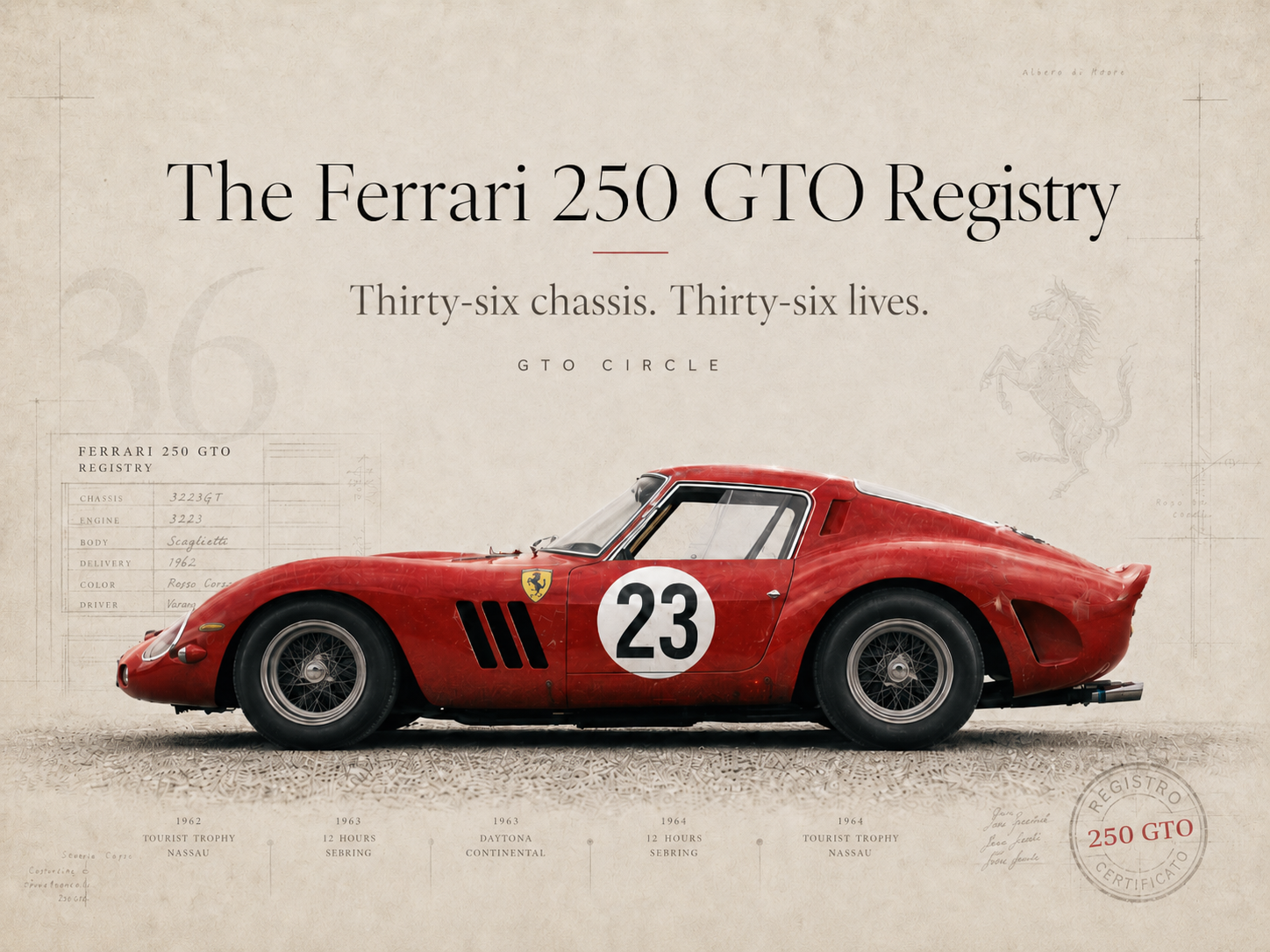

Leave a comment
This site is protected by hCaptcha and the hCaptcha Privacy Policy and Terms of Service apply.